
© www.duffieldderbyshire.co.uk 2002-2016
Make your own website with Xara Web Designer

www.duffieldderbyshire.co.uk
Duffield Hall
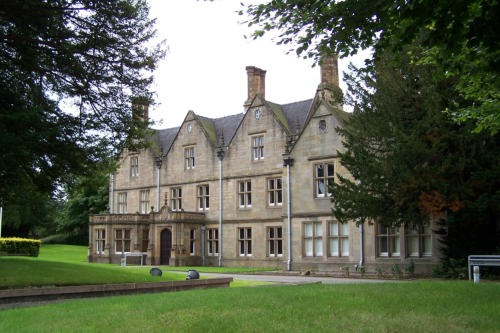
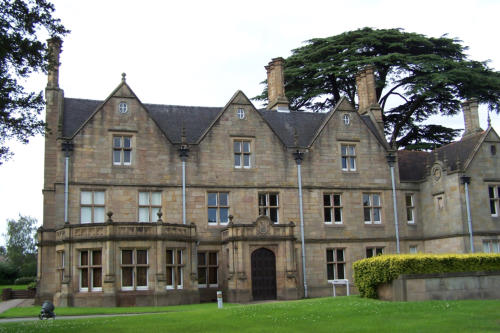
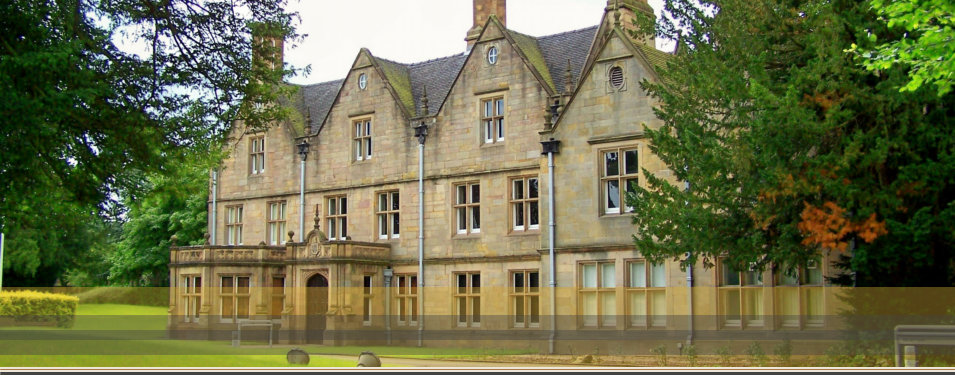
Duffield Hall, situated alongside the main road (A6) from Derby, is probably Duffield's best known building in the village. Unlike many other manor houses that have remained in the possession of one family for many generations, Duffield Hall has had a multiplicity of owners. As a result, very little is known about the building and not much more about its occupants. It is known that in mediaeval times the Manor of Duffield belonged to the Crown and that it was sold by that impecunious monarch Charles I, allegedly to pay his grocery bill. The first known residents of Duffield Hall were the Newton family and Thomas Newton, the first to be "of" Duffield, is believed to have built the Hall in the 1620's. Nothing is known of the architect but it is certain that the core of the building is Jacobean. The Newtons of Duffield died out in 1709 but it is clear that the original Thomas' son, also named Thomas, had disposed of the property during his lifetime. The next owner was Henry Coape who was described as being "of" Duffield when he was Sheriff of Derbyshire in 1703. Henry Coape's only son died without issue in 1778 and the estate passed to Henry Porter. Henry Porter was apparently also without a direct heir, as his estate passed via the related family of Bonell to Thomas Porter Bonell. His daughter married Sir Charles H. Colville, who is recorded as living at the Hall in 1829 and 1847. The Hall then passed to John Bell Crompton who was a member of a Derby banking family, but a noted dairy farmer in his own right. He continued to farm the Duffield land until 1870, but the Hall was sold to Rowland Smith in 1860. Duffield Hall auction sale notice of 1860. Link>> Rowland Smith was in residence during his term as Member of Parliament for South Derbyshire from 1868 to 1874 and while Sheriff of the County in 1877. He carried out many improvements and renovations, which were completed in 1871 and it is his crest which appears over the entrance porch. The Smiths continued to live at the Hall until after the first world war, when it ceased to be a private residence and was turned into an independent boarding and day school for girls, known as St. Ronan's. After the closure of the school, the Hall stood empty for a number of years and the building decayed. The once beautiful grounds were subjected to the ravages of time but some trees survived, principal of which was the famous Duffield cedar mentioned in White's Directory of 1857. In November, 1977, after more than four years planning and work, the Hall was taken into use as new headquarters for The Derbyshire Building Society. By that time, part of the grounds had been taken for housing and an access road built. The Society was faced with the dilemma of preserving what remained of the historic Hall and its grounds whilst at the same time providing modern accommodation for its Head Office operations. The problem was solved by the erection of a two-storey office block which harmonised with the Hall's colouring: the old building was renovated and adapted to provide branch facilities and conference lounge. The original reception hall became a busy branch for residents of Duffield and neighbourhood, where Derbyshire Building Society welcomes members who either want to transact their accounts or make enquiries about financial services. - In 1919 Mr. Andrew Hingley Snr. bought Duffield Hall Estate and he suggested to a Miss Gardiner that a private school she ran in the village could take over the Hall to have larger premises. Miss Gardiner then enlarged the teaching side and the facilities for sport were established in the grounds. In 1932 the two Miss Gardiners who rented the school retired and Mrs. Melbourne took over. In 1944 the executors of Mr Andrew Hingley Snr. sold it to her and it was then later sold byher daughter, Mrs. Mary Wrigley, to David Adams Builders. The original statement by the builder was that it would be used as a personal residence, and that Melbourne Hall could be disassembled, given to the village and rebuilt on a suitable site. The difficulty was in finding a suitable site, agreeing with the planning authority, carrying out the plan and organising the facilities. There was an offer to assist with the removal and reassembly but in the latter stages of the discussions the building was badly damaged by a site vehicle. The Hall was, subsequently, sold by the builders to the Derbyshire Building Society who the undertook to renovate, repair the old Hall and build the additional offices on the site. Since the demise of Derbyshire Building Society ,all the Gothic style office block as been demolish and replaced by a new housing estate, with the hall going into private hands.